Buzzers - [Learn & Grow]
What are Buzzers?
A buzzer is an audio signaling device that produces sound when an electric current is applied. Buzzers are used in electronics to provide audible feedback, alarms, or notifications.
Buzzers work on different principles:
- Piezoelectric buzzers - Use piezoelectric effect to generate sound
- Magnetic buzzers - Use electromagnetic coil and diaphragm
- Mechanical buzzers - Use mechanical oscillator
Common applications include:
- Alarms and alerts - Warning signals
- Feedback indicators - Button press confirmation
- Timers - Countdown notifications
- Games and toys - Sound effects
Buzzer Types
Active Buzzers
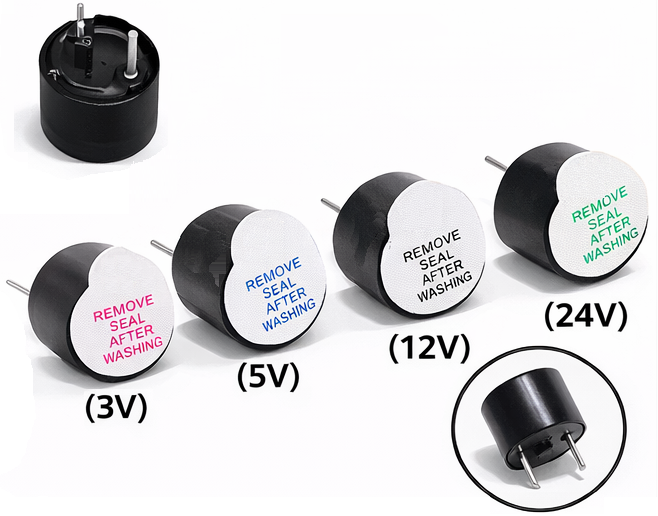
Active buzzers have an internal oscillator and produce sound when DC voltage is applied. They are simple to use but produce only one tone.
- Self-contained - No external circuitry needed
- Fixed frequency - Usually around 2-4 kHz
- Easy to use - Just apply power
- Used in - Simple alarms, indicators
Passive Buzzers
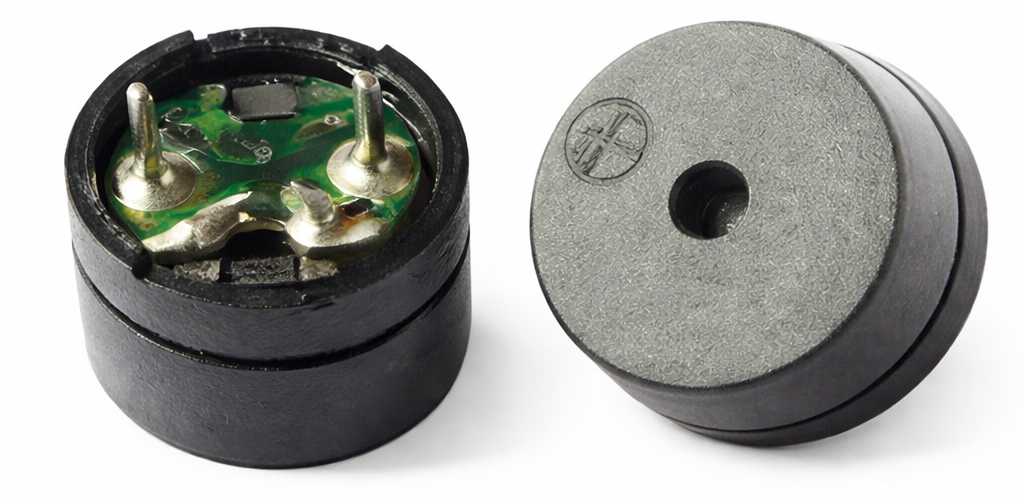
Passive buzzers require an external oscillating signal (AC) to produce sound. They can produce different tones and sounds but need more complex driving circuitry.
- Flexible frequency - Can produce various tones
- Requires driver circuit - Needs PWM or oscillator
- Better sound quality - Can play melodies
- Used in - Music devices, complex alarms
Piezoelectric Buzzers
These buzzers use the piezoelectric effect where certain materials generate voltage when mechanically stressed, or change shape when voltage is applied. They are:
- Compact and lightweight
- Low power consumption
- Wide frequency range
- Can produce different tones
Magnetic Buzzers
Magnetic buzzers use electromagnetic principles with a coil and magnet. They typically produce a single frequency but are:
- Louder than piezoelectric types
- Lower cost
- Simple construction
Buzzer Characteristics
Key Specifications
- Operating voltage - Usually 3-24V DC
- Sound pressure level (SPL) - Measured in dB, typically 70-90 dB
- Frequency - The pitch of the sound
- Current consumption - How much current it draws
- Resonant frequency - The frequency it naturally oscillates at
Driving Buzzers
Buzzers often require more current than a microcontroller can provide directly. Use a transistor as a switch to drive the buzzer:
- Base - Connected to microcontroller output
- Collector - Connected to buzzer positive
- Emitter - Connected to ground
For passive buzzers, use PWM (Pulse Width Modulation) to control frequency and create different tones.
Buzzer Polarity
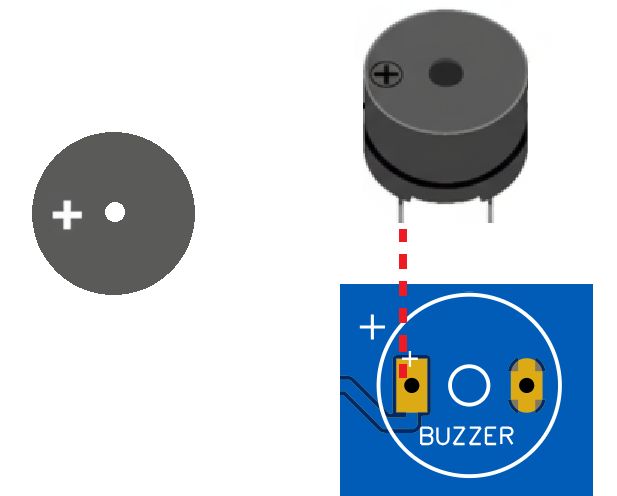
- Positive terminal → Usually marked with +
- Negative terminal → Usually marked with -
Assembly Tips
- Check polarity if marked
- Avoid mechanical stress on piezoelectric elements
- Test functionality after assembly
- Ensure proper ventilation for heat dissipation
- Use appropriate driving circuit (transistor or driver IC)
Next Steps
Ready to assemble? Return to Assembly Guide